
.png)
Single Agent or Multi-Agent? A Decision Framework for Enterprise AI
Harsh Dalal
Author
- Twenty-one typed dimensions decide the topology. Three are hard constraints that override the rest of the scorecard.
- Eight archetypes cover almost every production system, from a single agent with tools to a supervisor-and-specialists topology behind a governance boundary.
- Choose on evidence, not fashion. The deciding constraint is usually visible before the first line of code is written.
- Eleven minutes at the whiteboard would have saved one of the two teams below nine weeks in production.
Two demos, six months apart
The first went beautifully. Five agents fanning out across a research task, converging on a finished report in two minutes. Nine weeks later it still was not in production: three times the cost of a single agent, four times the latency, and nobody could say which of the five had gone wrong.
The second, a different client, also went beautifully. One agent, thirty-one tools, grown from nine over two quarters. Tool selection accuracy had been sliding for a month and the standup theory was that the model was not good enough. The model was fine. Nothing in that catalogue told the agent that reset_ont and reset_password belonged to different worlds.
.png)
Fig. 1 - Decomposition with no constraint requiring it; accretion with no boundary enforcing one.
Same mistake, opposite directions: choosing a shape before naming the constraint the shape has to satisfy.
Topology is a constraint satisfaction problem, not a style preference. The constraints are mostly not about the model.
The dimensions
Twenty-one typed signals. Hard constraints override the rest of the scorecard. The tree consumes eleven of them; the other ten are design review items.
The decision tree
.png)
Fig. 2 - Run the gates in order and stop at the first that fires.
- G1 can say “do not build an agent”. A framework that cannot reach that conclusion is a procurement justification.
- G2 outputs a boundary, not a topology. Take A7 as the outer shape, then re-run the tree inside each zone.
- G5 tests cohesion, not count. Twenty tools in one domain can stay single; six across three trust boundaries cannot.
- G7 asks whether conclusions compete, not whether subtasks separate. Disjoint slices are a supervisor; rival explanations are a blackboard.
- The tree can return nothing viable. That means the constraints are unsatisfiable: cut scope rather than relax a gate.
The eight archetypes
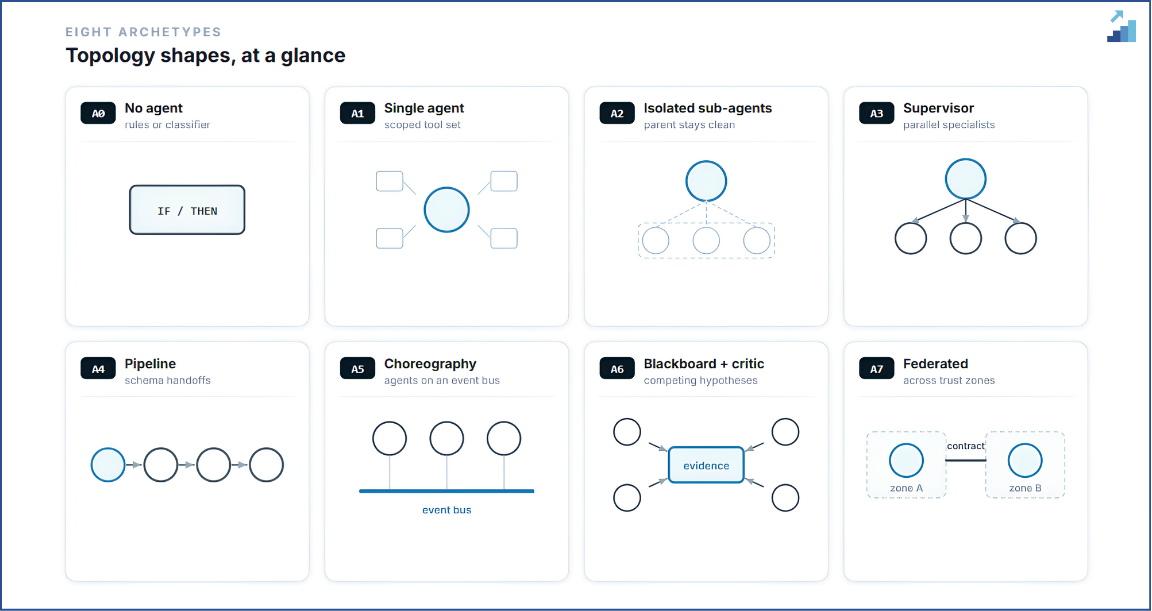
Fig. 3 - Eight shapes, from a deterministic classifier to federation across trust zones.
.png)
Fig. 4 - Latency tolerance against evidence volume. Anything right of your budget is unavailable to you.
Reference architectures
Six buildable shapes. A0 is a classifier, not an agent system; A7 is a boundary drawn around whichever of these six you chose. Read each for who holds the context, what survives a handoff, and where the write path is.
.png)
Fig. 5 - A1. One window, one domain, and writes through a single policy gate.
.png)
Fig. 6 - A2. The child scope is deliberately discarded; only a summary crosses back.
.png)
Fig. 7 - A3. Parallel work with a serial tail, and a supervisor window that only grows.
.png)
Fig. 8 - A4. The typed contracts between stages are the architecture.
.png)
Fig. 9 - A5. A state machine problem that happens to have agents in it.
.png)
Fig. 10 - A6. The critic makes it safe; the termination rule makes it finish.
Three worked examples
The same gates against three constraint sets, producing three different shapes.
Telecommunications: fault management, many operators
G2 fires on tenancy: no shared context, index, model memory or cross-tenant fine-tune. Re-running inside one tenant:
- G3 No. Minutes, not seconds.
- G4 No. One sustained session.
- G5 No. Alarms, topology, change and ticketing are not one domain.
- G7 No. The four specialists own disjoint slices, not rival explanations.
- G8 Yes. They run in parallel and fan-out cuts wall clock.
A3, inside A7.
.png)
Semiconductor: fab excursion and yield management
G2 fires once, on IP containment: recipe data cannot leave the fab, which forces on-premise inference and a small-model-plus-strong-tooling design. Model heterogeneity does not fire it; vision and time-series models are called as tools inside the boundary.
- G3 No. The budget is minutes.
- G4 No. A single sustained investigation.
- G5 No. Vision, MES genealogy, FDC traces and a report corpus.
- G7 Yes. Four agents propose competing explanations of the same excursion, and something has to adjudicate.
A6, inside A7.
.png)
Healthcare: prior authorisation
G2 does not fire, and everyone expects it to. PHI is a hard boundary, but the whole process sits on one side of it, and a boundary only fires G2 when work has to cross it.
- G3 No. Nobody is waiting in seconds.
- G4 Yes. Eleven days, waits on external events, must survive a restart.
A5. The tree stops before the decomposition gates, which is correct: where the case lives is a bigger question than how the reasoning splits.
.png)
After you choose
.png)
Fig. 14 - A1 to A3 is the move teams reach for first and need least; A3 to A5 the one they need most.
- Cost is the under-modelled dimension. The supervisor window is resent every turn, and each specialist re-derives the same background. On four specialists that re-derivation alone has matched the entire single-agent baseline.
- Prose is not an integration contract. Every arrow above is a schema. Handoffs carrying free text are why nobody can attribute a failure afterwards.
- Grade autonomy per action, not per agent. A permissions gradient lives in the control plane. Federation answers a trust boundary, nothing else.
Back to the two demos
The five-agent system was A1 in a costume: one zone, minutes acceptable, one session, nine tools in one domain, a case that fitted the window. The specialists were not answering different questions, they were answering the same one in sequence and paying a full context re-derivation each time. Eleven minutes at the whiteboard would have saved nine weeks.
The thirty-one-tool agent is the more interesting one, because the tree does not send it back to A1. G5 fires: three domains, no shared vocabulary. But the answer was never a bigger model, and never one supervisor over thirty-one tools.
Three cohesive agents of ten tools each, behind a supervisor that only picks the domain.
Both teams had the constraint that decided the answer sitting in front of them before the first line of code. Neither looked.
Choosing the topology is one piece of the architecture. What holds it together in production — the control plane that grades autonomy, gates writes and survives a handoff — is covered in The AI Agent Control Plane.
Working through this for your own architecture? Blue Data Consulting designs and delivers multi-agent enterprise platforms across telecommunications, manufacturing and healthcare. Start a conversation with our architecture team.
Frequently asked questions
What's the fastest way to decide between a single agent and a multi-agent system?
Run the elimination gates in order and stop at the first one that fires. G1 asks whether the outcome can be expressed as a rule or a classifier, in which case no agent is needed at all. G2 asks whether the task crosses a hard boundary such as data residency or independent certification. G3 asks whether a human is waiting in seconds. G4 asks whether the work spans days or waits on external events. Only after those four gates clear do the decomposition gates decide how to split the work.
Why did the five-agent research demo fail once it reached production?
It was decomposition without a constraint requiring it. The supervisor's context was resent every turn, and each of the four specialists re-derived the same background from scratch. That re-derivation alone cost 3.1× the tokens and 4× the wall clock of a single agent, for zero extra accuracy. The task never needed splitting in the first place.
Why did the 31-tool single agent's accuracy decline over time?
It was accretion without a boundary. The tool catalogue had grown from nine tools to thirty-one across three unrelated domains — billing, network and CRM — with no ceiling stopping it. Nothing in the catalogue told the agent that two similarly named tools belonged to different worlds, so selection accuracy slid. The fix was not a bigger model; it was three cohesive agents of ten tools each behind a supervisor that only picks the domain.
Which of the 21 dimensions actually override the rest of the scorecard?
Three are typed as hard constraints: outcome determinacy, data or trust boundary, and independent certification. If any of these fires toward the multi-agent side, it overrides every other signal on the list, regardless of how the other eighteen dimensions score.
What's the difference between a supervisor-and-specialists topology (A3) and a blackboard with a critic (A6)?
It comes down to gate G7: do the subtasks produce competing conclusions over shared evidence? If the specialists own disjoint slices of one answer, that's A3 — a supervisor reconciling parallel work. If several agents propose rival explanations of the same evidence that need adjudication, that's A6 — a blackboard with a critic and a termination rule.
Is federation (A7) an architecture in its own right?
No. A7 is a trust boundary, not a topology, which is why it isn't plotted on the latency-versus-evidence chart alongside the other archetypes. It tells you where the context stops sharing — across a tenant, a data-residency zone, or an air gap — and the decision tree is then re-run separately inside each zone to pick the actual shape.
What if none of the eight archetypes fit the constraints?
That outcome means the constraints as stated are unsatisfiable. The right response is to cut scope, not to relax a gate to force a fit. A framework that can only ever recommend building an agent isn't a decision framework — it's a procurement justification.
Harsh Dalal
Technology specialist and regular contributor at BlueData Consulting, sharing insights on machine learning, cloud architectures, and digital transformations.