

Forward Deployed Engineer Is An Operating Model
Anshu Pandey
Author
You have renamed your senior engineers and consultants as forward deployed engineers. The sales deck has a new slide. Six months on, the engagements look much as they did before: proofs of concept that stall, requirements that arrive as documents, architecture decided in review boards two steps removed from the client.
The pressure to fix this is real. Services firms are betting on the forward deployed engineer (FDE) as their answer to the question of what consulting looks like when AI does much of the build. Yet most of what has been written about the role describes the person: their skills, their seniority, their hiring profile.
This article describes the system around the person instead. It draws on three FDE enablement programmes we have designed and coached in the last several months, across healthcare, retail supply chain and customer experience, and banking. By the end you will be able to check your own practice against five conditions and see which of them you have actually built.
What "operating model, not job title" actually means
A forward deployed engineer is an engineer embedded with a customer, with the authority to build and ship directly against a live business problem. The value of the role comes from five conditions around the person: decision-first artefacts, a development lifecycle with gates, discovery as the default mode of work, a cadence of showing working and taking critique, and a ready environment. A firm that grants the title without building those conditions gets consulting output at an FDE day rate. Building the conditions is an organisational change touching commercial models, decision rights, governance and career paths, which is why it is an operating model rather than a hiring decision.
A firm that grants the title without building the conditions gets consulting output at an FDE day rate.
Why did the forward deployed engineer label travel without the system?
The label spread because it signals seriousness and customer proximity at no cost. The surrounding machinery did not spread with it because that machinery is expensive: it requires changing how a firm contracts, who may make architectural decisions, and how field learning flows back into methods and accelerators. Firms copied the visible part and left the invisible part behind.
Palantir's own description of the role states that the company pioneered the position by embedding engineers directly with customers, and that the role is a blueprint rather than a title.
Marty Cagan of the Silicon Valley Product Group makes a point that services firms tend to miss: the model works at Palantir because a platform organisation constantly generalises what FDEs learn in the field. Without that loop, a firm accumulates bespoke solutions that must be maintained indefinitely. The FDE is one half of a pair, and most adopters have copied only that half.
The name is cheap to copy. The operating model is not. Every cohort we have coached arrived technically competent; the gap was always somewhere else.
What three FDE enablement programmes revealed about the gap
Across the three FDE enablement programmes we have run, one in healthcare on AWS Bedrock, one with parallel Data Engineering, AI/ML and Business Domain tracks, and one built around decision intelligence in banking, the same four gaps appeared, usually within the first week. The clients, stacks and domains differed; the diagnosis did not. [internal link needed: FDE enablement programme service page]
First, participants were senior but had never taken anything to production. Asked what they had personally shipped that a business user depends on daily, the honest answer was a proof of concept, a stalled pilot, or a component someone else owned end to end. Services firms have organised work in layers, with handoffs, where nobody owns the outcome.
Second, they were model-first. Given a problem, the instinct was to reach for a model or an agent framework. The questions an FDE must ask first, which decision, who makes it today, with what information, measured how, came late or not at all.
Third, they expected to be told what to build. In a classroom this is natural. On a client site it is fatal, because the job begins where the requirements stop being handed over.
Fourth, every cohort wanted agentic AI. We designed around that, but it strengthened the model-first instinct rather than weakening it.
Why is the domain FDE the hardest and most valuable role?
The domain FDE is the hardest role to develop because it combines deep business credibility with the least production exposure, and the most valuable because the people who fill it already hold the client's trust. Technical FDEs can be hired from the market. Domain FDEs have to be built from existing senior consultants, and that building takes a deliberate programme.
Technical FDEs can be hired. Domain FDEs have to be built.
The three-track programme made this visible. The Data Engineering and AI/ML participants were closer to production already and recognised the lifecycle structure. The Business Domain participants, covering supply chain and customer experience, knew exactly how a planner or a marketer makes decisions but could not encode that knowledge into a system that runs. The artefact discipline described below became their bridge.
| Track | Starting strength | Starting gap | What the programme had to supply |
|---|---|---|---|
| Data Engineering | Pipelines, platforms, close to production | Framing work around a business decision | Decision card and KPI tree discipline |
| AI/ML | Models, evaluation, agent frameworks | Operating what was built; client-facing discovery | Lifecycle gates and in-role discovery practice |
| Business Domain | Client trust, decision knowledge, BRD fluency | Never shipped to production; model-first when asked to build | Ontology and agent design, a ready lab, ten consecutive build-and-present cycles |
The Five-Condition FDE Operating Model
The Five-Condition FDE Operating Model is the set of conditions that must surround an FDE for the role to produce outcomes rather than billable hours: decision-first artefacts, a lifecycle with gates, discovery as the default, a show-and-critique cadence, and a ready environment. We did not begin with this framework. It stabilised across three programme redesigns, each driven by a failure we watched happen, and we now treat it as both a curriculum design and a diagnostic for firms.
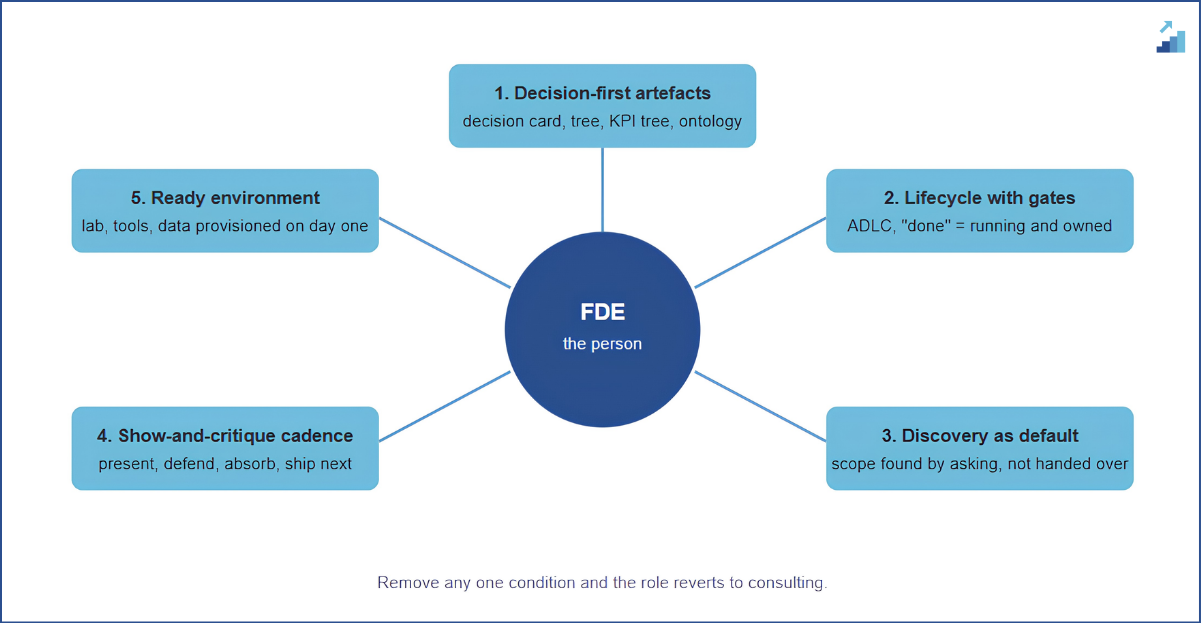
The comparison below shows how each condition looks when a firm has changed the title only, and when it has built the model.
| Condition | Title only | Operating model |
|---|---|---|
| Decision-first artefacts | Model or agent is the deliverable; impact asserted afterwards | Decision card, decision tree, KPI tree and ontology produced and tested before any agent |
| Lifecycle with gates | Demo is the finish line | ADLC stages with a "done" that means running, measured and owned by the client |
| Discovery as default | Requirements arrive as documents | Scope is found through structured questioning across functions and data |
| Show-and-critique cadence | Status reports; architecture decided in review boards | Working system shown and defended in short cycles; decision rights at the front |
| Ready environment | Access is the client's problem; weeks lost | Tools, cloud account and data provisioned before the first session |
Decision-first AI: the artefacts that come before any agent
Decision-first AI means anchoring every use case in the business decision it improves, and producing four artefacts before a single agent is built: a decision card, a decision tree, a KPI tree and an ontology. This is the first condition in the model and the one that does most of the work, because it inverts the model-first habit every cohort arrived with.
The decision card names the decision, its owner, its cadence, its inputs and what "better" means. The decision tree captures the logic a competent human follows today. The KPI tree connects the decision to metrics the business already tracks. The ontology defines the entities and relationships the decision runs on. Each is tested independently: the decision logic is exercised as a service against historical cases, the metrics are validated against the data, the ontology is checked against how the business actually describes its world. [internal link needed: decision intelligence methodology page]
An FDE who cannot produce a defensible decision card should not be near a client’s problem, however good their code.
Only then does the agent get built, to operate that decision rather than to impress. This matters more in agentic designs, not less. Each agent in a multi-agent system needs a decision it is accountable for, a metric it moves and an ontology it shares with its peers; without that, multi-agent systems become the microservices sprawl many of these firms spent a decade untangling. Architecture choices, single versus multi-agent design, control models, context engineering, the Model Context Protocol (MCP) and Agent2Agent (A2A), reliability and prompt caching, are threaded through as decisions the FDE must justify to a client, not as a technical module.
Why is the AI development lifecycle the pedagogy?
The AI development lifecycle (ADLC) is the pedagogy because participants who have never shipped anything learn the job only by carrying one system through every stage to production. Each programme day is one lifecycle stage. Two use cases are carried from framing through deployment to monitoring, and nobody is allowed to stop at the demo, where the last thirty percent of the difficulty lives.
The first session covers why the ADLC differs from the software development lifecycle participants know: probabilistic components, evaluation as a first-class discipline, data as a moving target, and no clean boundary between build and operate. For the firm, the implication is a lifecycle it actually follows, with gates between stages.
The rhythm inside the lifecycle is as important as the stages. Sessions run two hours, instructor-led, every working day for two weeks. Between sessions participants implement offshore and plan their own work. Each session opens with participants presenting their approach for five to ten minutes, followed by critical review, before the coach moves to the next stage. Ten consecutive presentations of the same evolving system produce the evidence an assessment rubric needs; a test cannot.
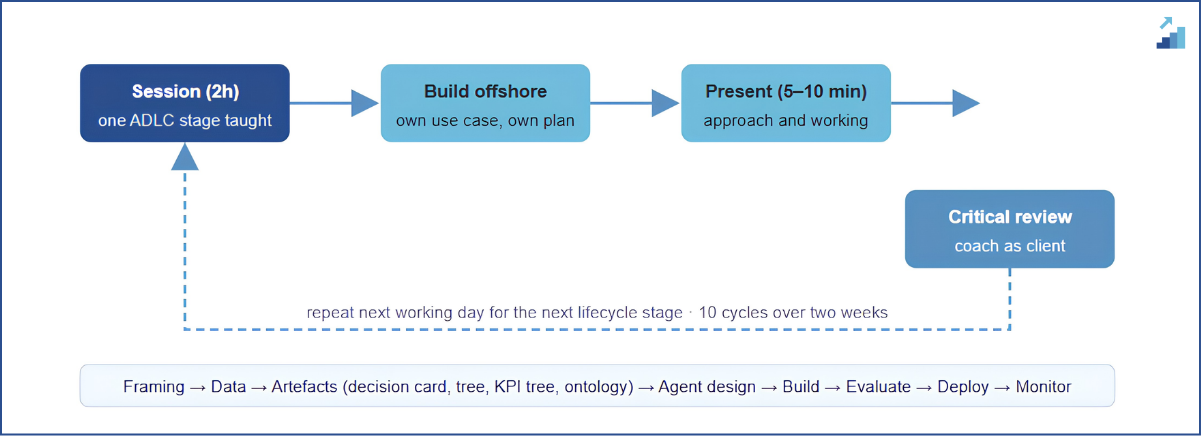
Figure 2. The build–present–critique cycle. The loop repeats once per lifecycle stage, so the same system is defended ten times before the programme ends. Source: Blue Data Consulting programme design, 2026.
Discovery over instruction: designing the case study to mirror the job
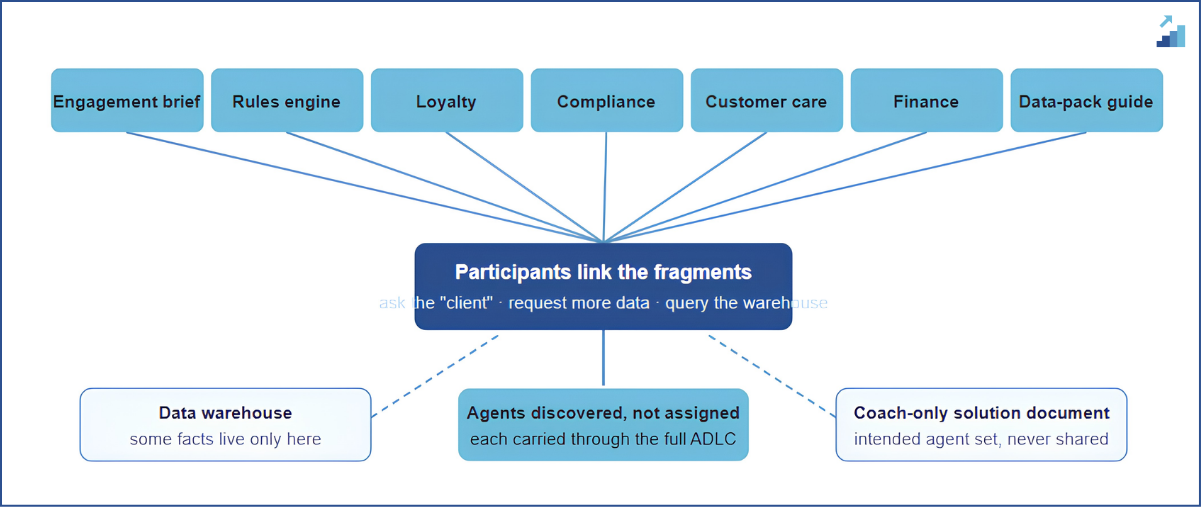
This was the most important design change across the three programmes. When participants were told what to build, they built it competently and learned little about the job. We rebuilt the case study so problems arrive as they do on a client site: fragmented, contradictory and spread across departments.
The current design uses a fictional retailer. Participants receive separate documents from different functions: an engagement brief, a rules-engine overview from operations, a loyalty programme summary, a compliance note, a customer-care perspective, a finance view and a data-pack guide. Some facts exist only in the data warehouse and must be found by querying it. Scope is deliberately left open, so participants must ask for what they need, and the coach answers in role as the client.
Participants are never told which agents to build. They have to discover them. The intended solution lives in a coach-only document, and the gap between what participants find and what the coach expected is where the learning happens. This is not a teaching trick; it is a description of the FDE's core skill.
What leaders must change to run the model, in order
If the FDE is an operating model, adopting it is an organisational change. From what we have seen, these five moves have to happen roughly in this order, because each one removes a blocker for the next.
- Standardise the four artefacts as your governance layer. Publish templates for the decision card, decision tree, KPI tree and ontology and make them the unit of quality review. Output: an artefact standard every engagement must produce before build begins.
- Adopt a lifecycle with gates and a hard definition of "done". Map your delivery method to ADLC stages and define done as running, measured and owned by the client. Output: a stage-gate document with exit criteria for each stage.
- Push decision rights to the front within guardrails. Define which architectural and scope decisions the FDE may make on site, and which need escalation. Output: a decision-rights matrix agreed with delivery leadership.
- Provision the environment before the engagement starts. Treat lab, tooling, cloud account and data access as a pre-engagement deliverable owned by your firm, not the client. Output: an environment checklist with a named owner and a day-zero readiness date. [internal link needed: managed lab environment page]
- Change what you sell and how people progress. Introduce at least one outcome-linked pricing structure scoped around a decision improvement, and create FDE as a grade with its own progression rather than a rotation. Output: a revised commercial template and a published FDE career track.
One condition sits outside this list because most services firms cannot build it directly: the feedback loop from field to product. You may not have a product, but you have accelerators, reference architectures and methods. If they do not change based on what FDEs learn on site, the "forward" in the title is decorative.
If field learning never changes your methods, the “forward” in the title is decorative.
Signals you have adopted the title but not the model
Each row below comes from a conversation we have had during a programme. Two or more and you are paying FDE salaries for consulting output.
| Signal | Missing condition |
|---|---|
| FDEs cannot name the decision their current work improves, or who owns it on the client side | Decision-first artefacts |
| Nobody on the engagement has personally shipped to production in the last twelve months | Lifecycle with gates |
| Requirements arrive as documents rather than being discovered through questioning | Discovery as default |
| Architectural choices are made in review boards several steps from the client | Show-and-critique cadence / decision rights |
| A new engagement's environment takes weeks to provision and is the client's problem | Ready environment |
| Field learning does not change your accelerators, methods or how you scope the next deal | Feedback loop |
| FDE appears in the sales deck but not as a grade or career track internally | Commercial model and career path |
Where this does not apply. The observations above come from three programmes with services-firm participants in India-based delivery organisations; the cohorts were small and senior. A product company with an existing platform team, or a firm hiring FDEs from the market rather than developing them, will find some conditions already met and others irrelevant. Treat the model as a checklist to argue with, not a rule.
Frequently asked questions about building an FDE practice
Is a forward deployed engineer just a consultant who can code?
No. A consultant who can code delivers what was specified, bills for the time and hands off. A forward deployed engineer discovers the decision worth improving, builds the system that improves it, ships it to production and owns the result, with the authority to make architectural choices on site. The difference is the conditions around the person, not the skill set.
How long does an FDE enablement programme take?
The domain track we run is ten two-hour instructor-led sessions over two working weeks, with participants building offshore between sessions. Programmes for other tracks and clients have been longer; one healthcare programme included a sixty-hour phase. Duration matters less than the cadence: the same system must be presented and critiqued repeatedly across every lifecycle stage.
Can senior domain consultants become FDEs without a coding background?
Yes, provided they know cloud, data and AI fundamentals and are willing to ship. In our programmes the domain participants had ten or more years of experience and had written business requirements documents but never taken a product to production. Agentic coding assistants and a pre-provisioned lab narrow the technical gap; the artefact discipline closes the framing gap.
What is decision-first AI and why does it matter for FDEs?
Decision-first AI anchors each use case in the business decision it improves and produces four testable artefacts, a decision card, decision tree, KPI tree and ontology, before any model or agent is built. It matters because it gives an FDE a defensible reason for every design choice and gives the firm a governance layer that travels between engagements.
Does the agentic AI shift change what an FDE has to know?
It raises the bar. The FDE is now designing a system of components that reason, act and hand off to each other inside an organisation that must trust and govern it. Single versus multi-agent design, control models, context engineering, MCP and A2A interoperability, reliability and cost patterns all become decisions the FDE must justify to a client.
The title is free; the forward deployed engineer operating model is the work
Three programmes have left us more convinced of the model, not less. When the five conditions are in place, senior domain people who have never shipped become people who can walk into an ambiguous business situation, reduce it to a decision worth improving, and build the agentic system that improves it. That change is real and it is teachable.
It is teachable only if the firm builds the operating model around the person. Rename people without doing that and you get what you always got, at a higher day rate. The one action to take this week: run the seven-signal diagnostic above with your delivery leadership and count honestly.
Anshu Pandey
Technology specialist and regular contributor at BlueData Consulting, sharing insights on machine learning, cloud architectures, and digital transformations.